VERMONT DOCTORS ARE WORRIED ABOUT CANNABIS.

Doctors want you to know the questions to ask about rising cannabis health risks in Vermont and what can be done to protect ourselves.
Vermont Can Be a Leader Again
The evidence about cannabis health risks is sobering, but it does not have to paralyze us. When Vermonters ask clear questions and talk with our neighbors, friends, and community leaders, we find practical, actionable solutions—just as we have done before on public health.
-
Dr. Dynasaur (1989) – One of the nation’s earliest universal coverage programs for children and pregnant residents.
-
Buprenorphine decriminalization (2021) – Vermont became the first state to decriminalize buprenorphine for treating opioid use disorder, a harm‑reduction approach highlighted as promising in evaluations by public health researchers.
-
Naloxone and harm reduction statewide – Vermont’s Opioid Overdose Prevention and Reversal Project works with community organizations to distribute naloxone, provide overdose‑response training, and connect people to treatment, helping prevent deaths across the state.
Now doctors are asking: can Vermont bring that same neighbor‑to‑neighbor, evidence‑based approach to rising cannabis health risks?
Q1: To reduce harm, why isn’t Vermont requiring child-resistant opaque, resealable and tamper-evident packaging for cannabis edibles?
RISING HARM
Accidental ingestion of cannabis by children is increasing.

VERMONT

Source: Product photos taken at Vermont cannabis retailer/ dispensary Jan. 2024
OTHER STATES

Sources: Examples for requirements in California, Colorado, Connecticut (white only), New York, Washington
Q2: To reduce harm, why doesn’t Vermont screen for cannabis use for all death autopsies?
THE NORM

76% of medical examiners and coroners routinely screen for marijuana/THC in toxicology autopsy testing.
VERMONT
Although Vermont has the highest cannabis use rate in the country, the state does not publicly report whether autopsies include cannabis screening, and cannabis is not included in state overdose toxicology reports.
OTHER STATES
Mandatory THC Toxicology Screening and alcohol in all non-natural deaths (suicides, accidental deaths, undetermined manner of death).
MODELS
-
Colorado C.R.S. § 30-10-624
-
Kentucky
-
ANSI/ASB Standard 119
Q3: To reduce harm, why doesn't Vermont use equivalent THC caps on vape concentrates to match edibles regulation?
RISING HARM
65% of Vermont high schoolers who used cannabis in the past 30 days vaped it - vaping is the dominant new mode of teen use.

VERMONT
Vape concentrates — typically 70-90% THC — captured 17% of Vermont monthly sales by October 2025, up from 0% in mid-2023. (Vermont lifted the ban on liquid vape concentrates in 2023 in Act 158.)
TOOLS & MODELS
Consider per-package potency labeling in equivalent "servings" for vape-cartridges (e.g., 5 mg THC) to match edible regulation.
Oregon
Colorado
Q4: To reduce harm, how will Vermont help people understand that the recent April 2026 federal reclassification of marijuana does not make it safe or legal?
RISING HARM
Emergency department visits for cannabis poisoning significantly increased between 2016 and 2022.

VERMONT
A dedicated Substance Misuse Prevention Special Fund was established (via Act 27 of 2025). Starting in FY 2026, 30% of the total excise revenue goes directly into this fund and 70% goes to the general fund managed by the Vermont Dept. of Health.
TOOLS & MODELS
Consider expanding the Vermont Dept. of Health's Cannabis prevention education to specifically include messaging on federal reclassification does not mean legal or safe.
MODEL
-
Maryland
Q5: To reduce harm, why isn’t Vermont requiring explicit, plain-language warning labels modeled on tobacco?
RISING HARM
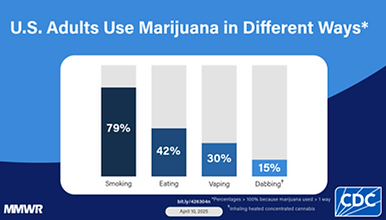
Smoking remains the #1 way U.S. adults use cannabis.
And 3 of the top-4 survey results involve inhaling smoke/ vapor.
SMOKABLE CANNABIS PRODUCT EXAMPLES IN VERMONT

Source: Product photos taken from Vermont cannabis retailer/ dispensary websites, May 2026
